
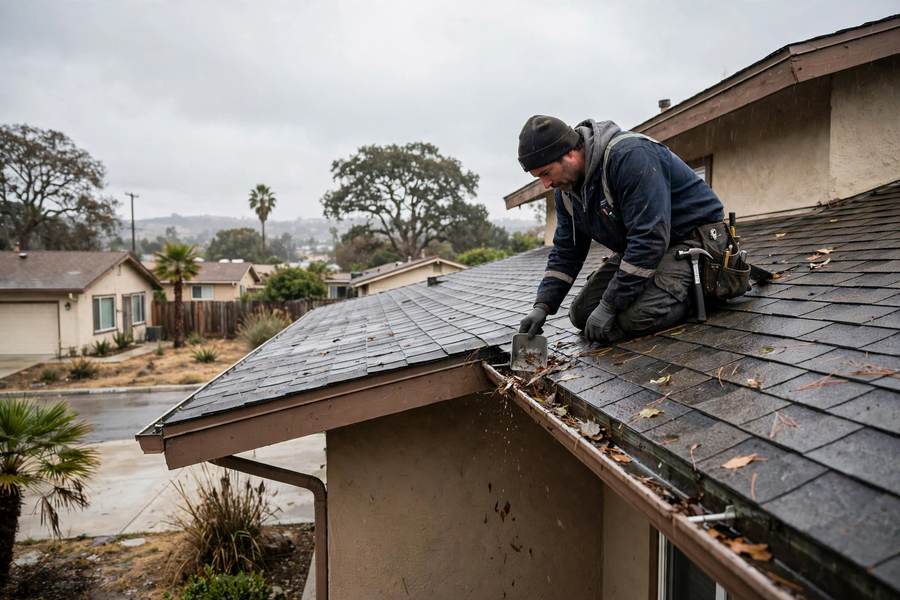
Winter rain in Northridge is concentrated, and that changes the preparation
Northridge does not get rain spread evenly through the year. It gets winter rain, concentrated, with February typically the wettest month at about 3.4 inches, and long dry stretches in between. Published summaries disagree on a single annual total, so we do not quote one as settled here. What matters for your roof is not the yearly sum but the burst pattern: months of sun and wind, then weeks when every weak detail is tested at once. Preparing for rainy season means finding those weak details before the rain does.
The right time is autumn, before the first big rain, and again after Santa Ana wind events, which fill gutters and lift shingle edges. A roof checked in October is a different proposition from a roof discovered in January.
Gutters and drainage first
Gutters are the most neglected part of rainy-season preparation and the most consequential. Clogged gutters back water under the first course of shingles, rot fascia, and send overflow down walls. Gutter cleaning before winter, and a check that downspouts actually discharge away from the foundation, prevents a whole class of winter damage. If gutters sag, separate at seams, or pull away from hangers, gutter repair belongs on the same visit.
Valleys deserve the same attention. Valleys carry the most water on a pitched roof, and debris in a valley slows that water until it finds a seam. Clearing valleys and checking the flashing beneath them is unglamorous work that prevents the most common winter leaks.
Flashing, boots, and seals
Flashing is where winter rain gets in. Check step flashing at walls, counterflashing at chimneys, and flashing around vents and skylights for cracks, rust, and sealant that has shrunk or split in summer heat. Our roof flashing repair and chimney flashing repair pages explain what a proper repair looks like, as opposed to another layer of sealant over a failed detail.
Pipe boots are the small part that causes a large share of winter leaks. The rubber hardens and splits under UV, and the split only shows when rain runs down the pipe. Replacing a split boot before winter is a small job; repairing the ceiling it stains in January is not.
Shingles, tile, and flat sections
Walk the ground around the house and look up. Missing, curled, or lifted shingles, especially after Santa Ana wind, are gaps winter rain will use. On tile roofs, look for slipped or cracked tiles, but remember the real winter risk is often the underlayment beneath the tile, which only an inspection can assess. On flat sections, check for ponding, blistered membrane, and failed seams, and consider whether roof coating or flat roofing work is needed before rain, not during it.
Attic ventilation belongs on the same checklist. In Climate Zone 9, poor ventilation traps condensation in winter and heat in summer, and both age the deck. If the attic shows condensation staining, ask about ventilation installation when you call.
A short pre-season checklist
- Clean gutters and downspouts, and confirm discharge points.
- Clear valleys and check valley flashing.
- Inspect flashing at chimneys, walls, vents, and skylights.
- Check pipe boots for splits.
- Look for missing, curled, or lifted shingles from the ground.
- Check the attic underside for staining, damp insulation, and daylight at penetrations.
- Trim branches that overhang the roof, so wind does not scrape them across the surface all winter.
If anything on that list is beyond a ground-level look, call Dravon Pulse Roofing at (424) 255-3700 for an roof inspection or a written quote. We are open 24 hours, every day, and we work across Northridge, including Roscoe and the surrounding pockets.